
The Victoria Mines that produced Cannel Coal
By Donn Wimmer
In 1968, and the Hancock Clarion published its 75th Anniversary Edition with a historical recap of Hancock County’s history. I had been talking to a friend, Ray Quinn, at the time and he told me about the Old Victoria Mines near Patesville. I was intrigued and knew this would be a good story for the anniversary edition.
What is cannel coal?
A few miles south of Patesville, there is a seam of cannel coal. It is a type of coal with a large amount of hydrogen, which burns easily with a bright light and leaves little ash. Legends trace the discovery of the deposit to 2 hunters who found the outcrop.
It is said that around 1837, the English government, apparently working through a New York mining company, purchased a large tract of land in the southeastern portion of Hancock County, bordering Breckinridge County. The mining company that was quickly established operated under the name of Breckinridge Cannel Coal Company. The community that sprang up around the mines was comprised of many English and Irish immigrants who had come to work in the mines.
The small town was soon to be named Victoria, in honor of Queen Victoria of England (1837-1901). The old Victoria school house still stands near the mine. The Hancock County Historical Society had planned to restore it.

The Victoria School a few years ago.The Hancock County Historical Society had plans to restore it, but it’s too late now as it has collapsed into a pile of rubble. It was located on State Route 1700 south of Patesville. Photo by Donn Wimmer
We do not know to what degree this may have been true, but we do know that, to date, the Breckinridge Cannel Coal Company, Victoria Mines, as it was called in this area, became the largest operation in Hancock County.
A railroad was built from Cloverport to the mines, on which the coal was hauled to Cloverport, where oil was extracted from it and shipped to England. The coal was very light in weight and contained a large amount of oil. People used the small lumps of coal for kindling and workers whittled trinkets from it, such as rings, bracelets and necklaces.
There were stores, a hotel and a post office. A number of people lived in the town and surrounding communities who worked in the mines at $1.50 a day.
Mr. George Bentley came from England, as the bookkeeper for the mining company, and later married a Miss Miller from Cloverport. He and Mrs. Bentley later moved to Hawesville where they were prominent citizens for a number of years.
Dr. C.M. Heavrin practiced medicine at Victoria during this time, also moving to Hawesville in later years.
Many English and Irish people came to Victoria to work in the mines. Among those who traveled here were those with the last names: Ryan, Quinn, Rooney, Shore, Reardon, Burk, Sullivan, Freel, McGovern and Tierney. Most of them remained and many of their descendants still live in Hancock County.
The Cloverport crude oil production remained until 1898. Then, its closing was forced due to a decrease in demand and oil wells opening in Kentucky and other parts of the country, along with the near exhaustion of cannel coal.
The railroad
Ray Quinn took me out to the location in 1968 and there we met the owner of the land at that time, a Mr. Taulbee. We walked through the woods and Taulbee showed us the remnants of the old railroad that transported the coal to Cloverport.
I don’t think there is much left of the old railroad or mines. The Victoria school has disappeared into ruin, I have been told.

This photo in 1968 shows the remains of the once-thriving Victoria Mines, J.H. Taulbee who was 94 at that time, shows a chunk of coal to Ray Quinn. Some of the coal can probably still be found at this site although it would be a good idea to get permission from the present land owner before you go out there. Photo by Donn Wimmer
How Cannelton got its name
I have always wondered if Cannelton, Indiana got its name from cannel coal. Checking Wikipedia, I found this: “The name Cannelton was adopted in 1844 and is derived from the cannel coal that was once mined in the area.”
I have always been interested in history, especially Hancock County history. I wonder what it was like back in the 1800s when Patesville was a good size town and their neighbor, Victoria, was also a thriving community.
Ray Quinn’s memories
I interviewed my friend of many years, Ray Quinn, this past week to get some of his memories of the mines and some history of Patesville.
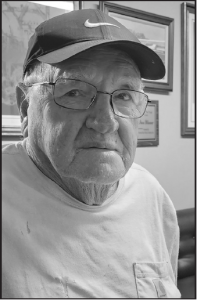
Ray Quinn
“We called the owner ‘Old Man Taulbee.’ He was in the oil business, and still owned that land in 1968,” Ray Quinn said. “He may’ve been from Owensboro; he lived in Owensboro when I knew him. He said he attended The World’s Fair in 1936, in Dallas, Texas, and they had a lump of coal on display. People laugh at me for telling this, but I’m just telling you what he told me. He said it weighed a ton, from this mine here in Hancock County. It was supposedly the largest chunk of cannel coal in the world.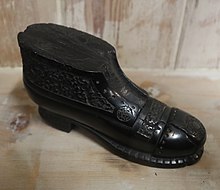
He didn’t know that one day he’d own the land with the mine that the lump of coal came out of. That would be a coincidence, wouldn’t it?…The reason he was telling me the story is because, little did he know, he would own that land someday.
They had several oil wells there, over the years. I remember the wells myself. Joe Marsch was an oil well driller. Later years, there was an outfit out at Madisonville – a banker. They owned oil wells in Madisonville. The Badgetts, I believe. He came to see my dad, seeking information on this coal mine. My dad owned one probably at that time. I happened to be there. Somebody told him he needed to go see Joe Marsch, the driller. He would know about it, because he drilled all over that country. He went to see Joe and he told him there was a vein of coal 25-30 feet deep, which is in unheard of. He was way out of proportion on that. But, that’s what he told him.
Joe said he had a problem moving the rig from one barn to the other. There was a fence and he had to get permission from the farmer to cut the fence so he could move his rig over there. They wouldn’t allow it, so Joe told the farmer that he had called the queen up and she told him to go ahead and cut that damn fence. He told that story. He was well-known to tell [stories].
My grandfather’s name was Pat Quinn, my dad’s dad. I never did see him. He came here at 16-years-old from Ireland. He was a traveling door-to-door salesman. He had a backpack. I don’t know how he did it. They ordered and then received the items through the mail, I guess. He couldn’t have carried all the items. He’d be gone for days at a time; he was walking. He was dead before I got to meet him. There were no pictures of him.
My dad (Marcus Quinn) farmed all his life. As a young boy, he and his brothers would go to Illinois during harvest season and pick corn by hand. That was the only way to survive and make it.
Dad’s brothers were Pat, Jr., John and Mike. He had one sister, Mary. She moved to Butler County and married a Sheppard around Morgantown. They owned and ran a small store. Mary’s son, Marcus, named after our dad, owned a big IGA store in Morgantown. That was in the 1950s.
Marcus owned what we called The Baker Place.
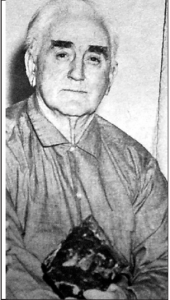
Marques Quinn in 1968, holding a lump of Canel Coal that was carved to resembling like a Bible. I got to be good friends with him and enjoyed listening to his memories of the Victoria Mines.
He didn’t buy that until we were teenagers, probably. It was divided into 4 parts. The Bakers divided it and would sell to my dad. They were successful. They liked my dad. They lived here in Hancock County. They sold that to my dad one section at a time so that he could afford to buy it – 520 acres total. Back in the old days, nobody had any money. They made it to where he could buy it. He finally got it all. They reserved half of the mineral rights on the hill part, not the bottoms.The guy that bought that, who now owns it, he got in touch with me. He owns a 16th of the mineral rights. I told him about my dad buying them out, but there’s no proof of it. I told him to go to the courthouse and I think he did, but had no luck. I can’t see my dad buying half the mineral rights and it not being recorded.
Dad had about 100 head of cattle all the time. He had the 520 acres and one above that was 100 acres, and then he had one across from our land that was 75 acres. In Breckinridge County he owned 70 plus acres in Ball Town. It has a lot of oil in it, but it’s too heavy to pump. That’s where it got its name – Tar Springs. It’s 25-30 feet thick. They talked about heating it, maybe. They do that elsewhere. They never did do it here. I imagine he owned about 600-700 acres total. They also had their homeplace, which belonged to the family. It was 300 acres.
Cecil Brown owns it. He went back there and built a 15-acre lake and has a log cabin on the water. He owns the land that Mr. Taulbee owned.
I’ve farmed most of my life, and I went down to work at Commonwealth. I always tell everybody that I never got out of the woods, you know. I don’t know how I made it, but I got into the oil business and did pretty well with that. I’m doing alright now. We’re working on a oil well over there now for three weeks. I’m not doing the work itself, but I’ve been there supervising it. It’s an outfit out of Poole, Kentucky.
I’m 85. I still walk every day, except about 3 weeks ago I came down with a gout in my toe twice. It laid me up. Now I’m too busy to walk. Maybe next week we’ll get donewith it and I can get back to walking.”
Ray has walked so much at Vastwood Park that they named a trail after him. “I kept count of my miles walking for 13 years,” he said. “It took me 13 years to walk around the earth. I walked around the earth and never left Hancock County. I have them all written down on a calendar – 24,901 miles, I believe – walking around Vastwood. First few years, I walked out there 3 or 4 times a day. I’d come home and have nothing to do and go back. One time I went 27 laps. I stopped several times. I wanted to get 30 laps in one day, but it was midnight and it went over into the next day.”
Up until 3 weeks ago, he said he was walking about 4 laps a day at Vastwood Park.
Cannel Coal Mine
“All I remember was this outfit out of Madisonville came in there and re-opened it,” Quinn said. “They owned banks in Madisonville and in Hancock County. They put the coal in 25-pound boxes and shipped it across the country. They came in there and stripped it. They cut it up in big slabs, brought it up there and dumped it. They had it on a conveyor and washed it. Then, they had these boys chip it with a hammer and put it into the 25-pound boxes.”
Victoria Schoolhouse
“My mom and dad went to the old schoolhouse,” Quinn said. “Back then it had a dirt road. I always heard bad tales about that place up here, that the boards were mean and would cut you, fight and use knives. Victoria had a bad name. The school had a bad name. Dewey Ramsey owned the store and had a pickup truck and we rode up there with him. There were boys up there my age – 10 or 11-years-old. I was afraid of them. We went outside and mingled and they were really nice to us. All that stuff I heard probably wasn’t true.
I remember going there one time. The school was active then. The Cartwrights went to school there. My grandmother was a Tierney. I remember her. She lived with my mother and dad when she was dying. Dr. Ferguson from Cloverport made house calls. When she died, they had the body in the home those days.
My mom was Alma Snyder Quinn. Myrtle Marsch was her sister. My Aunt Lula Snyder was a school teacher. Mother lived to 100. Aunt Lula lived until 102. My aunt who lived in Evansville lived to be 100. Dad passed at 76.”
Donn Wimmer is the Publisher of Hancock Clarion

My dad worked up to the coal mine for years
I now own 3600 acres in Hancock and Breckinridge countries which includes Victoria Crossroads. I have found and am renovating the old railroad bed. I will try to find entrances to the old mines. There was the old Victoria Hotel which I do not know where the site was?
If anyone has info about area history I would like to hear from you. My cell 502-552-4644. Fred Pape