| logout
Harrises lead advanced K-9 training for Hancock County Search and Rescue
PROTECTED CONTENT
If you’re a current subscriber, log in below. If you would like to subscribe, please click the subscribe tab above.
Username and Password Help
Please enter your email and we will send you a password reset link.
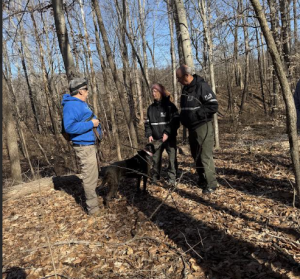
Hancock County Search and Rescue team member and K-9 handler Tony Cilia, with K-9 Eureka, joins volunteer instructors Jackie and Keith Harris, who traveled from Michigan to teach new training methods and offer constructive feedback on Feb. 13 and 14. First responders trained at several locations, including Hancock County High School, Jeffreys Cliffs, Vastwood Park and the Lewisport boat dock.
By Jennifer Wimmer
Members of the Hancock County Search and Rescue team, along with the Hancock County Sheriff’s Office, Tell City Police Department, Perry County Sheriff’s Office and Hardinsburg Police Department, with assistance from the Dukes and Hawesville volunteer fire departments, conducted two days of training on Friday, Feb. 13 and Saturday, Feb. 14.
Team members and volunteers participated by helping to hide and track for the Hancock County K-9 handlers and their dogs. Hancock County Search and Rescue coordinator and K-9 handler Amy Tipton organized the training.
Participating were Hancock County Search and Rescue members Tony Cilia with K-9 Eureka, Amy Tipton with K-9 Rocco, and Brandon Boone, who has nearly completed the required year of training with his K-9, Heki. Hancock County sheriff’s deputy and K-9 handler Cody Axton trained with the team.
Participating from other agencies were Tell City K-9 handler Triton Martin with K-9 Duncan and Perry County K-9 handler Trevor Vaal with K-9 Jack. An officer from the Hardinsburg Police Department also trained with the team at Hancock County High School and joined Axton and K-9 Max for narcotics search exercises on Saturday.
Keith and Jackie Harris were volunteer instructors who traveled from Michigan. The Harrises assist with the Southern Michigan K-9 Search and Response Unit and the Branch County Sheriff’s Office Victim Services Unit. Keith Harris is a reserve deputy in Branch County, and Jackie Harris volunteers with the sheriff’s office. Both are K-9 handlers with bloodhounds trained for various searches, including missing persons or fugitives.
The Harrises are not part of an apprehension team, but their dogs help guide officers by alerting when they are close to a scent. When the dogs signal a proximity alert, the Harrises let law enforcement know the person is in the general area, allowing apprehension dogs to take over if needed.
Tipton met the couple during an out-of-state training session and invited them to Kentucky to help the Hancock County Search and Rescue team learn new training methods and offer constructive feedback to the county’s K-9 handlers.
First responders conducted training at multiple locations in Hancock County, including Vastwood Park, Jeffreys Cliffs Conservation and Recreation Area, Hancock County High School and the Lewisport boat dock.
Six Hancock County High School students volunteered and the team was given permission to use the Hancock County Middle and High School campus as a training site. Student volunteers earned credit toward their required community service hours.
Twenty-two volunteers participated on Friday. The team trained from 9 a.m. to 7 p.m., starting at Jeffreys Cliffs from 9 a.m. until noon, then continuing at the Lewisport boat dock for the rest of the day.
Thirty-seven volunteers participated on Saturday from 9 a.m. to 3 p.m. Training began at the high school from 9 a.m. until noon, followed by afternoon sessions at Vastwood Park.
Boone said the team focused on realistic, scenario-based training rather than basic drills.
Typically, handlers practice starts and turns on short straight-line tracks, often about 100 yards with a single additional 25- to 50-yard turn. The goal is for handlers to move just out of the dog’s sight after making a turn so the animal follows the scent rather than relying on sight.
Trainers want to avoid what they call “sight-bracing,” when a dog simply spots a person at the end of the trail and runs directly to them. During tracking exercises, the hiding volunteers move slightly out of view so the dogs must rely on scent to locate them and perform a “final approach” or “final alert.” A dog’s alert can differ depending on its training — some may sit and look back at the handler while others may bark.
Much of Saturday’s training focused on school-related searches to help law enforcement and the rescue team prepare for potential student emergencies, such as a child being abducted or failing to arrive in class.
Tipton structured the two-day session specifically around K-9 training because the Harrises specialize in that area. Volunteers from the fire departments acted as “rabbits,” or decoys, by hiding so the dogs could track and locate them during the exercises.
Volunteer firefighter and Director of Hancock County Emergency Management Kyle Veach coordinated with Hancock County High School staff to arrange permission for students to volunteer on Saturday.
The team conducted several real-life, scenario-based training exercises. One example involved a situation where a student failed to report to class, possibly due to special needs, and needed to be located.
Boone said student volunteers sat at different desks in classrooms while handlers collected scent articles from those desks so their K-9s could track them through the school. The team practiced both indoor and outdoor searches, starting inside before following trails that sometimes led over a fence near the high school.
When a dog reached the fence, handlers trained for three options — going over, under or around it. A low enough fence would allow for them to lift, for example, a 60- to 70-pound dog over, but they also practiced as if facing eight- or ten-foot fences that required rerouting and restarting the trail.
In one scenario, two students hid in separate areas and the dogs had to locate the correct one based on scent. Instructors gave each handler a scent article from either a male or female student so the dog could identify the right person.
Heki was assigned to find a male student who was hiding about 30 to 40 yards beyond where a female student was hiding. When he reached the female, he briefly checked her, then put his nose back to the ground and continued searching, indicating she was not the correct decoy. He then followed the trail to the male student and gave his final alert.
Boone said these scenarios mirror situations they might face at school events in heavily “contaminated” areas, meaning places with many different human scents present. At the high school, more than 300 students move through the building each day, so the dogs must filter through hundreds of scents to locate one specific person, which was a key focus of the training.
They also ran an abduction-style scenario. Handlers were told they were looking for a specific student who was last seen leaving a set of doors and was supposed to board a bus but never did. They cast the dogs in that area, let them smell a scent article from the student and then gave the search command. In the scenario, the student had been placed in a vehicle at the bus stop in front of the middle school.
Boone said the dogs followed the scent trail around the campus to the bus stop and then indicated that they had lost the scent there, marking the last place the student had been. A pickup truck carrying the student then drove past the K-9 handlers. As it went by, the dogs caught the student’s scent again, lifted their heads toward the truck and began to follow it, simulating a situation where a child is taken from the bus stop in a vehicle and the dogs can indicate that they are inside that vehicle.
I asked what happens if the abductor had tried to mask the scent in some way and if the K-9 would still be able to detect the child’s scent in that situation.
He said even if someone tried to cover a scent, the dog would ignore that odor and keep searching for the specific scent it had been given. He explained that K-9s can pick out a target scent under layers of other smells.
In one drill, a volunteer rubbed a paper towel in his hands, balled it up and placed it in a metal bowl. Even after they lit the towel on fire, Perry County’s K-9 was still able to track the person using only the scent left in the ashes.
In another training exercise, nine people stood in a circle and passed a piece of paper from hand to hand so each person touched it. The paper was then placed in the middle of the circle and one person quietly stepped away. Handlers brought in their dogs, had them smell the paper, then check each person still standing in the circle to rule out their scents before giving a search command. The dogs were then able to track and find the person who had left.
The team also practiced at Jeffreys Cliffs because its size, trails and cliffs make it a likely place for a hiker to become lost or injured. They wanted both handlers and dogs to get used to that kind of terrain. In one exercise, they practiced “find another,” where dogs were sent to locate two people: after finding the first subject, the dog was put back on the scent and told to search for the second. This reflects real situations in which hikers are in pairs or groups and one person may be hurt while another becomes disoriented while trying to go for help.
During training at Vastwood Park, members of the team talked with Steve and Karen Robertson, the new owners of The Galaxy Pizza restaurant. After explaining what they were doing, the Robertsons offered the restaurant for training.
“We worked a scenario where we had a man with an altered mental status and his 19-year-old son. They went and sat in the restaurant and then they left and went different directions. We took our dogs in The Galaxy, took a scent article from the chair they were sitting in and went out and found the subject,” Boone said.
The fictitious situation involved a father with Alzheimer’s disease who went out to dinner with his son. After an argument, the son went to the restroom and came back to find his father gone, called 911 to report that his dad had run off and then started searching for him.
Responders in the exercise were told which table the two had used, which chair the father sat in and that he had Alzheimer’s, and the dogs were started on the trail by scenting from that chair before the search moved forward.
Training there also helped prepare responders to find a missing child. An autistic individual, for example, may be drawn to the nearest water source during a stressful situation. With the new splash pad, nearby lake, campgrounds, playgrounds and ballfields, it would be critical to quickly locate a child who wanders.
“We worked some scenarios for adult and child sex trafficking also,” Boone said. “One was where three individuals were in a pickup truck. The truck drove down the road and it was a bail-out scenario. All three ran away and we caught two of them. We kept those two at the truck, brought our dogs over and told them to check. Then we put the dogs in the truck and gave them the same check scenario. The dog looks at you, like, ‘Ok, I know which one I’m looking for now.’ So, we pull them out of the truck and they were able to track down the third person, or the missing person.”
He added, “In a trafficking situation, if they were to pick someone up, drop that child off or drop the victim off for whatever reason, we would be able to take the two people or one person in that vehicle, eliminate their source of smell and say either ‘Yes, our victim was in this vehicle and this is where that vehicle came from or the direction of travel from that vehicle,’ or we can eliminate that altogether and say, ‘No, that’s not the case; they were not in there.'”
He said that in order to do this with the dogs, they run “negatives,” or take a scent from someone who is not training with them or has not been in that area. They put the scent article on the ground and tell the dogs to check and give the search command and since that scent is not where they just checked, they’ll give an indicator.
“They will not try to search for a scent that’s not there, that’s not in that area,” he said. “So, we’re able to say either that person has been here and this is their direction of travel or this person has not been here because our dogs are not alerting on that scent.”
He encourages parents and caregivers to make simple “scent packages” for their children using a sterile gauze pad and a sandwich bag. At large events like Fourth of July fireworks at Vastwood and others, he suggests wiping the gauze around the child’s neck, sealing it in a labeled bag and taking a current photo of the child in that day’s clothing. If the child goes missing, a recent photo and clean scent article can help K-9 teams start searching quickly. He notes that gauze and bags are inexpensive, the process takes only seconds and the preserved scent remains usable for a long time.
“Something that simple will help out tremendously if it’s needed,” he said. “We all hope we never have to use a fire extinguisher, but there are a ton of people who have one in their house somewhere.”
At the Lewisport boat dock, the team ran a drowning scenario in which a subject walked from the parking lot around the fenced recycling area to the river, briefly stepped into the water, then left by vehicle a few blocks away. Using a scent article, the dogs tracked the route to the water’s edge, sometimes checked briefly in the river, then alerted at that spot as the last place the person left scent, indicating where a search on or in the water should begin.
They also worked scenarios involving missing people who may have been picked up in a vehicle, including kidnapping, abductions, hitchhikers and vulnerable adults such as individuals with Alzheimer’s or autism who might accept a ride from a stranger. At intersections, multiple volunteers either walked in different directions or got into cars and exited at the next intersection. Handlers cast their dogs to each corner so the K-9s could identify the last corner the person had stood on and the direction of travel, following the subject’s odor trail even after they were inside a moving vehicle.
Boone said one negative incident arose when a homeowner posted on Facebook that the team had trained in his yard without permission, claimed there were 10 officers there and that one told him to mind his own business, and that they had asked the team several times to leave.
He said none of that happened, noting that trainings are recorded by the instructor and most members wear GoPros, and that only three officers were present: a Tell City police officer, a Perry County deputy and Deputy Cody Axton with K-9 Max.
He explained that the property backs up to a fenced utility area by the boat dock where the decoy was hiding and because the dogs work on a 30-foot lead, one handler briefly cast through what the homeowner considered his yard. The man, standing on his porch, asked if everything was OK and what was going on, and the handler apologized, explained they were doing training, asked if he was the decoy, and when he said no, told him there was no problem and continued the exercise. Boone said that was the only exchange, no one was rude, and they were not training on the man’s property.
He explained that the property backs up to a fenced utility area by the boat dock where the decoy was hiding and because the dogs work on a 30-foot lead, one handler briefly cast through what the homeowner considered his yard. The man, standing on his porch, asked if everything was OK and what was going on, and the handler apologized, explained they were doing training, asked if he was the decoy, and when he said no, told him there was no problem and continued the exercise. Boone said that was the only exchange, no one was rude, and they were not training on the man’s property.
He added that advance notices about the exercises in Lewisport and Hawesville — stating there was no threat to the community and that increased law enforcement and emergency vehicles were due to training — had been shared widely, and it bothered him to see the situation portrayed otherwise.
“Other than that, the training went well. All of our volunteers were amazing and all of our handlers did really well. We thank Amy Tipton for coordinating all of this, and the Harrises for volunteering their time and helping us be able to put a bunch of realistic scenarios in place. That’s what we wanted to do and it’s what we accomplished,” he said.
Hancock County Search and Rescue K-9 training is held twice a week, weather permitting, and if everyone can attend based on their regular work schedules. The more intensive training that was conducted with instructors last weekend was in addition to their regular training.
Boone will complete his year of training with Heki in June and then find an evaluator so they can be tested to be state-certified.
“Amy is part of our Kentucky State Task Force now as well,” he said. “Kentucky State Emergency Management has decided to put together an urban search and rescue disaster team including K-9 handlers, and she was accepted in a position with them. She will be traveling all over the state of Kentucky and is in the process of training a new dog.”
Search and rescue teams must notify Kentucky Emergency Management and obtain an incident number for each training session so that if anyone is injured or a real-life emergency occurs, participants are covered under Kentucky state workers’ compensation. They are also required to keep a roster of everyone who attends, including volunteers who are not part of an agency to ensure full accountability.
Boone pointed out that many people may “confuse professionalism with a paycheck.”
“What they might not understand is that our volunteer fire departments, search and rescue team and dive team, just because they don’t get paid to do it, doesn’t mean they are not professionals,” he said. “They all have training they do on a regular basis. We’re training. We’re taking time away from our families. We’re putting in the hours.”
2026 First Responders Day
The 2026 First Responders Day is scheduled for Saturday, May 16 at the Hancock County Middle School, from 10 a.m. to 2 p.m. The event is free and a golden opportunity for the community to connect with first responders from the four local volunteer fire departments, police and sheriff departments, EMS and search and rescue.
The community can ask questions, learn about public safety and see emergency vehicles up close. There will also be fun activities for all ages, safety demonstrations and information booths, food trucks and refreshments.
“What we’re trying to stress is that this is a day for the community. You do not have to be a first responder to attend. We’re trying to raise awareness through action or education. We’ll have a lot of demos set up. We’re hoping to educate the community on what we do,” Boone said.
First Responders Day offers the public a chance to meet first responders before emergencies occur and to learn about their vehicles, equipment and procedures. The event aims to make future crises less traumatic by helping residents recognize the faces and names of those who serve them. Attendees can also learn valuable tips on emergency preparedness, planning and how to respond in different situations.
U.S. Army veteran Spc. Brandon Boone is an EMT, a former Ohio County sheriff’s deputy and a firefighter with Dukes and Hawesville volunteer fire departments. He is also a member of the Hancock County Dive Team, in addition to serving with Hancock County Search and Rescue. He is currently running for Hancock County constable in District 2.
Boone and Heki will begin narcotics certification training next week and are expected to complete the certification within six to eight weeks.
Follow the Hancock County Search and Rescue Facebook page to stay updated.
Posted in Breaking News, Local News 2