Courage under fire
PROTECTED CONTENT
If you’re a current subscriber, log in below. If you would like to subscribe, please click the subscribe tab above.
Username and Password Help
Please enter your email and we will send you a password reset link.
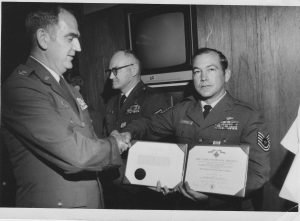
As a member of the United States Air Force during the Vietnam era, LT Newton flew as a flight engineer on 164 combat missions. Each mission consisted of several different roles all wrapped into one flight, with some missions lasting as long as 14 hours.
“Any time we went into the air we were subject to coming under fire,” Newton said. “Whether it was from other aircraft, surface-to-air missiles or anti-aircraft fire.” Newton said they often took off early in the morning, flew into North Vietnamese airspace and radioed back a weather report to Saigon.
“They (air command) would launch all the strike missions for that day provided the weather was proper,” Newton said.
After providing the intelligence for the day’s airstrikes, Newton’s flight, call sign Crown, then headed out to the Mekong Delta River region and loitered in the air to potentially perform their other role that day: Search and Rescue of downed pilots. These missions came with great danger involved. A Search and Rescue mission consisted of several different aircraft working as a team to rescue the downed pilot.
“We had an EB-66 (Destroyer electronic warfare aircraft) high in the sky with all kinds of electronic equipment on board to jam their radar and everything,” Newton said. “We had two fighter jets out to our wingtips to take care of their Migs, and two Sandys (Douglas A-1E Skyraider ground attack planes) flying below us to take care of the ground fire.”
Newton flew in a Douglas C-54 Skymaster plane, and his plane’s role was to detect the rescue signal from the downed pilot. Once Newton’s plane located the downed pilot’s signal and the scene was secured, rescue personnel were sent in to extract the pilot.
“They would send a Jolly Green Giant (Sikorsky HH-53) helicopter in with PJs (Para rescue personnel) to extract them,” Newton said.
Newton vividly remembers one Search and Rescue Mission. He said they tried for three days to rescue the pilot, but were not successful. He said when the North Vietnamese shot down a U.S. plane, the first thing they did was race to the crash site to secure the communications equipment, especially the rescue beacon. They would then activate it and lay a trap for the rescuers.
“They kept suckering us in,” Newton said. “Finally they got us where they wanted us and the sky literally lit up with all kinds of armament.”
Newton said Search and Rescue personnel encountered extremely intense enemy fire, and the unit suffered a casualty. The North Vietnamese shot down one of the A-1E aircraft piloted by a Captain Hutchinson. Newton described him as a strong Christian man, but knew something bad happened when he heard Hutchinson utter the curse g—d— over the radio. As the flight engineer, Newton sat at his station between the pilot and co-pilot.
“I looked up and there was a big ball of flame,” Newton said. “No one survived it. Naturally we got out of there.”
Newton said he thinks the downed pilot was already dead, or captured because the North Vietnamese managed to recover the communications equipment from the pilot, or the crashed airplane. The Search and Rescue team headed back to air station over Thailand as they waited for further orders. Not long after they received new orders to head to North Vietnam to rescue another downed pilot.
“For some reason when they said we got one down over North Vietnam go get him, I just became so nervous it was pitiful,” Newton said. “It scared the living daylights out of me for some time for some reason.”
While on route to the location, air command in Saigon contacted them and told them to abort the mission due to it being extremely dangerous. Newton said air command did not need to tell them the dangers of the mission, they already knew it!
Special training
Since the type of missions Newton flew entailed a very high risk of being shot down, crews underwent special training on how to resist the interrogation techniques employed by the enemy. Newton did not want to go into much detail on what the training entailed, but the classes taught them how to endure the physical, emotional and mental torture employed by the enemy to break U.S. service personnel.
Newton did relate one humorous detail from this training. The training occurred in Washington state, and his unit was sent out into the field on a training assignment, which the unit completed successfully. As a reward his unit received a tame rabbit to eat. Newton said he started to clean the rabbit, and his instructor stopped him and told him he needed to clean the rabbit in such a way as to preserve the rabbit’s pelt. Newton said the instructors told him his unit needed to preserve the pelt so they could make gloves or coverings for their feet as needed. After removing the pelt, Newton said he then started to cut up the rabbit. While cutting up the rabbit, Newton said he went to throw away the eyeballs. Again the instructor told him to never throw any part of the rabbit away, and to eat the eyeballs.
“All the people around me were city slickers and they were gagging and carrying on,” Newton said. “I thought, ‘Man if it takes eating those eyeballs to get that rabbit I am going to eat those peckerwoods!’”Newton said he popped an eyeball in his mouth and started chewing. He said it felt like a large rubber marble and just rolled around in his mouth. Newton said the instructor told him not to chew it, but to simply swallow it.
“It felt like swallowing a goose egg!” Newton said.
Entering the service
Newton enlisted in the United States Air Force in 1954, and retired in 1975. He rose to the rank of Master Sergeant. He served as a flight engineer for 11 years.
As a flight engineer, Newton monitored all of the planes instrumentation. He watched the performance of the engines, the props, throttles, controls and flaps, and the landing gear. A C-54 Skymaster consists of four engines, which means the cockpit contains many gauges and dials.
Newton monitored the aircraft’s performance preflight, during flight and post flight. He ensured the aircraft contained the proper amount of fuel for their mission, calculated how long they could fly before having to head back to base, checked the aircraft over before take-off, made sure the plane contained the necessary equipment for the mission and other vital information.
“I sat up front between the pilot and co-pilot and monitored all the instrumentation and the actual function of the aircraft,” Newton said. “I did everything except sit there and steer it.”
Newton’s role as flight engineer allowed the pilot and co-pilot to give their undivided attention to simply flying the airplane. During a Search and Rescue mission when under heavy enemy fire, the pilot and co-pilot do not need to be distracted from flying the plane because they need to check gauges or other instrumentation. Newton’s job allowed them to fly unencumbered.
Newton’s first deployment to the Vietnam theater occurred in 1964 and lasted three years. He received a posting to Utah, and stayed there seven months before being shipped back overseas, this time to the country of Vietnam. That tour lasted one year. He then went to Georgia for a few months before being posted to Okinawa, Japan.
Lunar mission training
In addition to serving combat missions in Vietnam, Newton also served on missions supporting the Apollo moon shot flights. His unit’s duty was to serve as Search and Rescue if something went wrong with one of the Apollo flights, and it made an emergency splashdown in the ocean.
“Every time they launched one we would go to various places in the Pacific and stand by there,” Newton said.
Their role was to attach floatation collars to the space capsule to keep it from sinking. Newton said they never were called upon to engage in such a rescue mission. Though they never actually participated in an ocean rescue mission for the Apollo program, they practiced for such an occurrence. Newton recalls one such practice mission.
“One time Carroll Miller, our squadron commander, got down so low (over the ocean) we had to turn on the windshield wipers in the aircraft,” Newton said. “I said, ‘Carroll, I think it is about time you pulled this thing up a little bit!” Newton said Miller told him, ‘Nah, this is fun!”
Miller was flying so low over the ocean that the turbulence from the plane’s props was sucking up water and spraying it over the cockpit windshield.
Military honors
During his air force career, Newton received 13 medals, including the Distinguished Flying Cross. He received this award in 1974.
“When I got the Distinguished Flying Cross I was actually stationed on Guam,” Newton said.
While Newton cannot relate the exact details about the mission on which he received the cross, he can say it was for his aircraft’s role in electronic warfare missions. In addition to the cross, Newton received six air medals, a National Defense Medal, Good Conduct Medals, Commendation Medals in addition to receiving his Senior Aircrew Wings.
Post service
After he retired from the U.S. Air Force, Newton came back to Hancock County and settled into civilian life. He became active in the community, and joined the South Hancock Volunteer Fire Department over 30 years ago.
“I am still chief of the department,” Newton said. “I have been for 20-something years.”
In addition to serving on the fire department, Newton remains active with the local VFW and helps locate the graves of service personnel to ensure they receive proper recognition each year. He also finds and cleans up old cemeteries to preserve them for posterity. Newton also serves as a magistrate on the Hancock County Fiscal Court, and recently completed his 13th year on the court. It is his second stint on the court.
“I like to stay active in church,” Newton said. “That is the most important thing in life.”